Corresponding States Principle (CSP) Viscosity Model - What is it, and how does it really work?
This series explains why viscosity modeling for petroleum fluids can be messy in practice. The starting point is that viscosity data are often limited or uncertain, and the models used in commercial PVT workflows are not always what their names suggest.
The main target of the series is the model often called the "CSP model" or "Pedersen model." The key message is that this name can be misleading. The model is not just one clean corresponding states model. It is a combination of different pieces:
- A true corresponding states part for lighter, lower-viscosity fluids.
- A methane reference viscosity model.
- A North Sea empirical oil correlation, often the Rønningsen correlation, for heavier and more viscous oils.
For many oil systems, the dominant part of the model may not be CSP at all. It may be the empirical Rønningsen correlation. This matters when moving models between software packages, tuning model parameters, or judging whether model predictions are trustworthy.
Useful Background
The pseudo-CSP / Pedersen-style workflow can be thought of as a switching or blending of multiple different viscosity models based on how light or heavy the fluid is.
The light-fluid side uses corresponding states ideas with methane as a reference fluid. The heavier-oil side may use the Rønningsen empirical correlation. The practical warning is simple: selecting a model called "CSP" does not always mean that every part of the calculation is truly CSP.
Post-by-Post Summary
Post 1: Why Viscosity Modeling Is Difficult
The first post introduces viscosity modeling as a difficult area because of limited data, uncertain data, and the challenge of building a model that works across gas, liquid, light oil, and heavier oil conditions.
Key ideas:
- The Lohrenz-Bray-Clark (LBC) model is common for petroleum mixtures and works well for gases and many reservoir fluids.
- LBC can struggle for heavier and more viscous fluids.
- The so-called CSP model, also called the Pedersen model, is commonly used as another option.
- This "CSP model" is actually a combination of separate model pieces.
- For many oil systems, the model being used is not really CSP, but a North Sea empirical oil correlation.
Source: Post 1
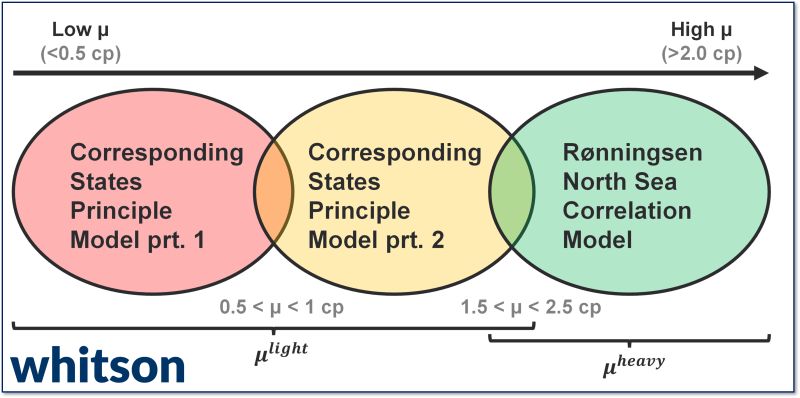
Post 2: How the Pseudo-CSP Model Switches Between Sub-Models
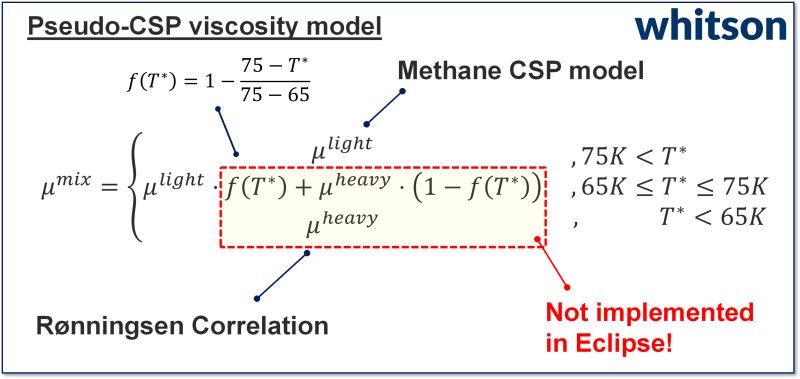
The second post explains that the so-called CSP model combines a true CSP-style light-fluid model with the Rønningsen heavy-oil correlation. The question is how the model switches or blends between these pieces.
Key ideas:
- The lighter-fluid viscosity is represented as .
- The heavier-fluid viscosity is represented as .
- A reference temperature, written as , helps decide how the actual mixture maps to the methane reference system.
- Higher temperature generally means lower viscosity; lower temperature generally means higher viscosity.
- Different commercial simulators may implement this model differently.
- Some software packages include the full blending approach, while others omit the Rønningsen part.
- Tunable parameters can also differ across software, which can strongly affect predictions.
Source: Post 2
Post 3: Reference Conditions and Model Flow
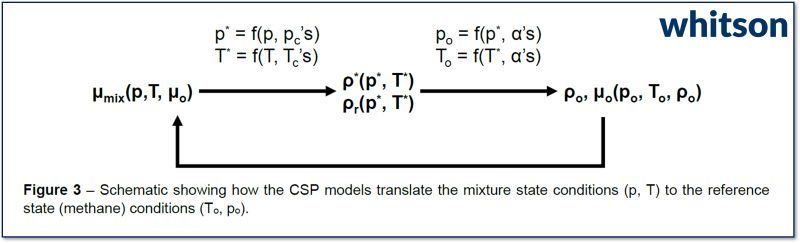
The third post zooms out and shows the high-level calculation flow. The actual fluid conditions and properties are translated into reference conditions, which are then used to calculate either a methane-reference viscosity or the Rønningsen oil viscosity.
Inputs include:
- Actual pressure and temperature, and .
- EOS-derived properties such as critical pressure and critical temperature.
- Component molecular weights.
- Scaling factors used in the corresponding states transformation.
The post emphasizes that the workflow is intricate. Even at a schematic level, the method involves several transformations before the final mixture viscosity is calculated.
Source: Post 3
Post 4: The True Corresponding States Part
The fourth post focuses on the actual corresponding states part of the pseudo-CSP model. This part translates the real mixture into equivalent conditions for methane, then uses a methane viscosity model to estimate mixture viscosity.
Key ideas:
- Methane is used as the reference component.
- The model translates mixture conditions to methane-like reference conditions.
- Average fluid properties such as critical temperature, critical pressure, and molecular weight are needed.
- Scaling factors are also needed.
- The averaging rules for fluid properties are not trivial and are not unique.
The simplified idea is:
Once the methane reference state is found, the methane viscosity model can be used as part of the mixture viscosity estimate.
Source: Post 4
Post 5: Methane Reference Viscosity Model
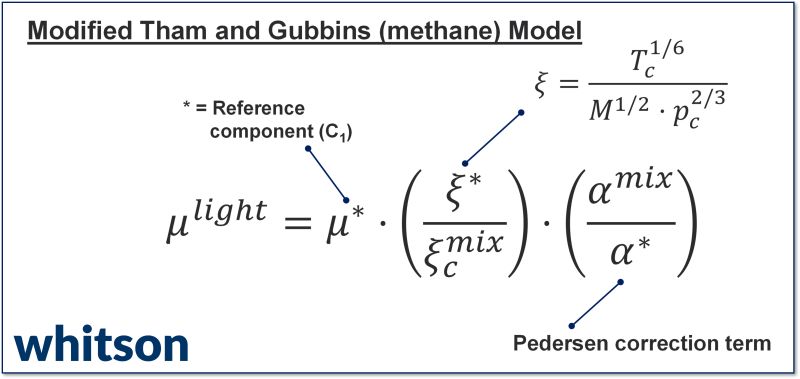
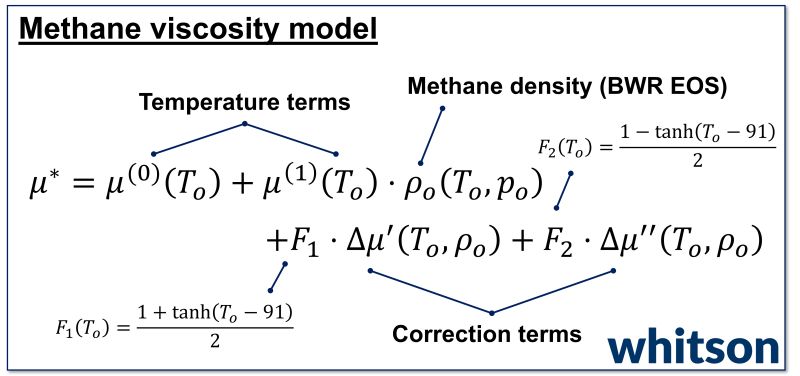
The fifth post explains the methane viscosity model used in the CSP side of the workflow. The model is described as a modified version of the Tham-Gubbins model.
Key ideas:
- The methane viscosity model includes temperature-dependent terms.
- It uses methane density, calculated with a BWR equation of state.
- It includes separate correction terms below and above a methane reference temperature of about 91 K.
- The 91 K split is related to issues around methane freezing.
- The BWR density calculation is computationally heavier than a simple formula.
- This can make the CSP viscosity model slower in compositional reservoir simulation workflows.
Source: Post 5
Post 6: The Rønningsen Heavy-Oil Correlation
The sixth post asks the central naming question directly: are you really using a CSP model when you select the so-called CSP viscosity model? For oils, the answer may be no.
Key ideas:
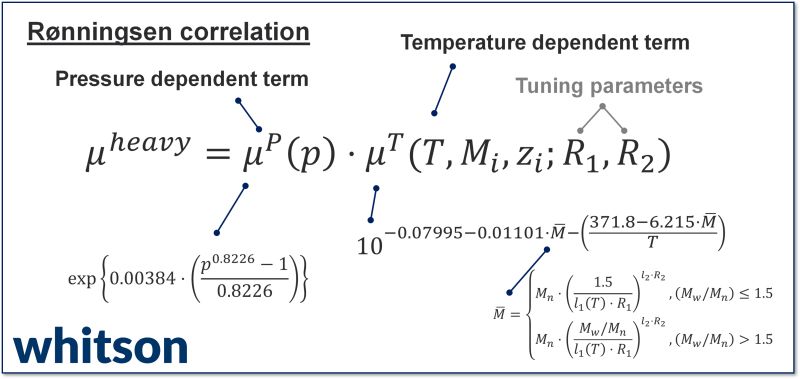
- For oil viscosity, the model may rely mainly on the Rønningsen empirical North Sea oil correlation.
- The Rønningsen model is not a CSP model.
- It has a pressure-only part and a pressure-and-temperature-dependent part.
- The original publication includes two tunable parameters, often called and , in the second part.
- Commercial software may expose more, fewer, or different tuning options.
- Not all simulators implement the Rønningsen part, so exporting a "CSP" model between tools can change the result.
Source: Post 6
Post 7: Comparing the Model Against Measured High-Viscosity Data
The seventh post returns to the most important modeling principle: a model is only useful if it predicts measured data well enough for the job.
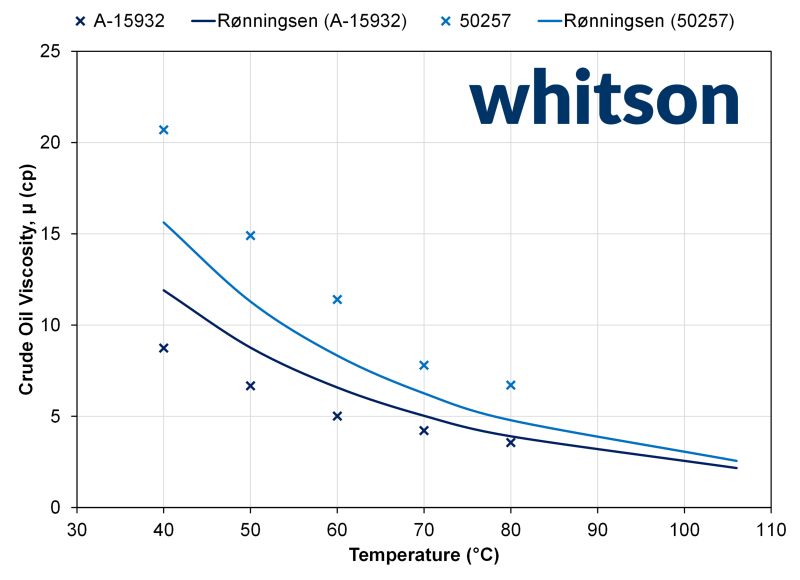
The post looks at high-viscosity crude oil data and compares predictions using default model parameters. For viscosities above roughly 1-2 cP, the so-called CSP model is mostly using the Rønningsen correlation rather than the true CSP part.
Key ideas:
- High-viscosity oil data are a good stress test for the model.
- Default model parameters may not be enough.
- The example uses published Volve field fluid datasets from Equinor.
- The comparison reinforces the need to check predictions against measured data, not just trust a model name.
Source: Post 7
Main Takeaways
- Viscosity modeling is hard because data are limited, uncertain, and fluid behavior changes strongly across gas, light oil, and heavy oil systems.
- LBC is common and useful, but it can struggle for heavier and more viscous fluids.
- The so-called CSP or Pedersen viscosity model is really a combination of multiple model pieces.
- For lighter fluids, the workflow uses corresponding states ideas with methane as a reference fluid.
- For heavier oils, the workflow may rely mainly on the Rønningsen empirical North Sea oil correlation.
- Software implementations differ, so the same model name can mean different calculations in different tools.
- Tunable parameters are important and may not transfer cleanly between simulators.
- High-viscosity oil predictions should always be checked against measured data.
Practical Implications
When using or transferring viscosity models, ask:
- Is the model really using CSP for this fluid, or is it using an empirical heavy-oil correlation?
- Does the software include the Rønningsen part of the model?
- Which parameters are tunable in this specific implementation?
- Are the same parameters available in the destination simulator?
- What viscosity range does the fluid fall into?
- Are there measured viscosity data to compare against?
- Are default parameters being used, and are they good enough for the fluid?
The series makes a very practical point: the model name is not enough. You need to know which sub-model is active, how your software implements it, and how well it matches measured data.