Peng-Robinson vs Soave-Redlich-Kwong - Is one better than the other?
This series asks a practical PVT question: which cubic equation of state is better, PR or SRK? The point of the series is not to answer from habit, preference, or folklore. The point is to compare model predictions against measured data.
The series starts by framing the PR vs SRK debate, then reviews how the cubic EOS family developed from van der Waals to RK, SRK, and PR. It then introduces the plots used to compare model behavior, selects a measured methane dataset, and compares "vanilla" PR and SRK models before and after adding volume shifts.
The early conclusion is deliberately modest: for methane density predictions, unshifted PR and SRK both perform poorly for liquid-like densities, while shifted PR and SRK both perform well. Based on the methane cases shown so far, neither model clearly wins. More datasets are needed before making a broader claim.

Useful Background
A cubic EOS normally splits pressure into a repulsive part and an attractive part:
For SRK, the commonly used form is:
For PR, the attractive term uses a different denominator:
In plain language, helps account for molecular size, helps account for attraction between molecules, and adjusts attraction with temperature.
Post-by-Post Summary
Post 1: PR vs SRK Should Be Tested Against Data
The first post introduces the recurring industry question: which model is best, PR or SRK? The post argues that this should not be decided by strong opinions or model-to-model comparisons alone. It should be tested against measured data.
Key ideas:
- PR and SRK are the two most common cubic EOS models in industrial PVT work.
- Engineers often debate which is better, but the debate is often based on speculation.
- The right way to compare models is to calculate predictions and compare them to measured data.
- The series sets out to make that comparison visible.
Source: Post 1
Post 2: How the Cubic EOS Models Differ
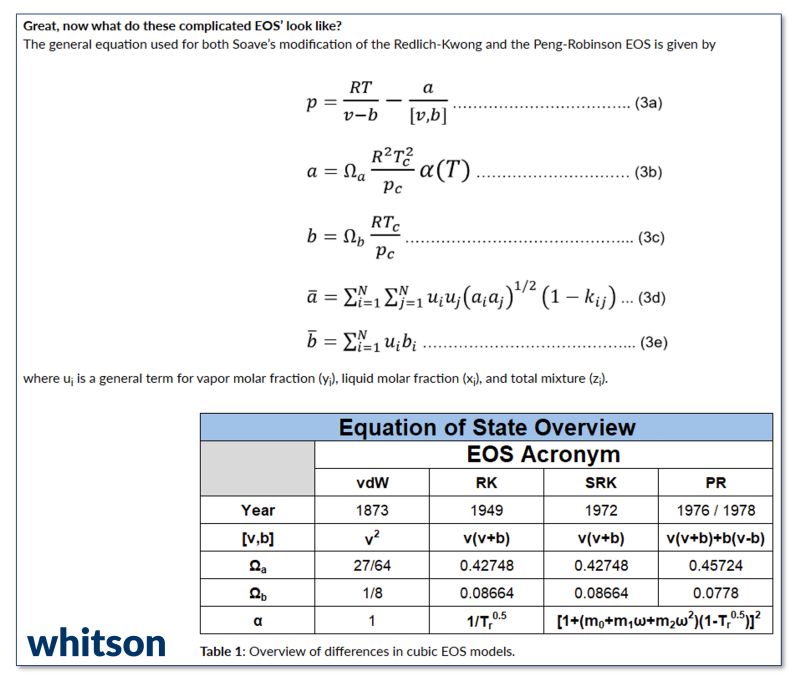
The second post gives the model background needed before comparing PR and SRK. It places the models in historical order: van der Waals, Redlich-Kwong, Soave-Redlich-Kwong, and Peng-Robinson.
Key ideas:
- van der Waals introduced the basic cubic EOS idea, but it is not what engineers would normally use for modern calculations.
- Redlich and Kwong modified the attractive pressure term in 1949.
- Soave improved the RK model in 1972 and produced SRK.
- PR was developed with petroleum engineering applications in mind, including improved liquid-density behavior for heavier hydrocarbons.
- PR and SRK look similar, but they differ in the way the attractive term is written.
Source: Post 2
Post 3: Plots Used to Judge Model Predictions
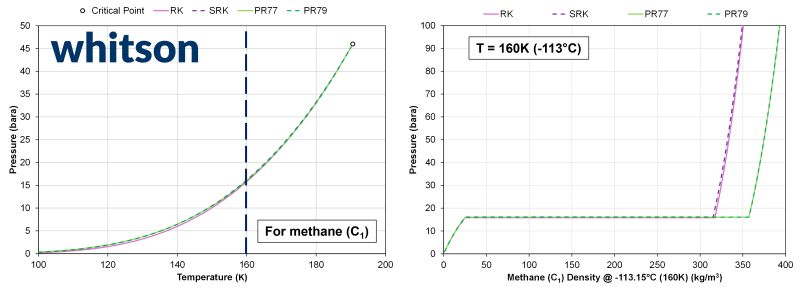
The third post introduces the basic comparison plots that will be used before moving into more complex cases. The initial focus is on single-component systems and two practical views of model performance.
Plots used:
- Vapor pressure versus temperature, to look at phase-change behavior.
- Density versus pressure at fixed temperature, to look at volumetric behavior.
The models shown for methane are RK, SRK, PR77, and PR79, all without volume shifts. This establishes the baseline before model corrections are introduced later.
Source: Post 3
Post 4: Methane Dataset for Model Testing
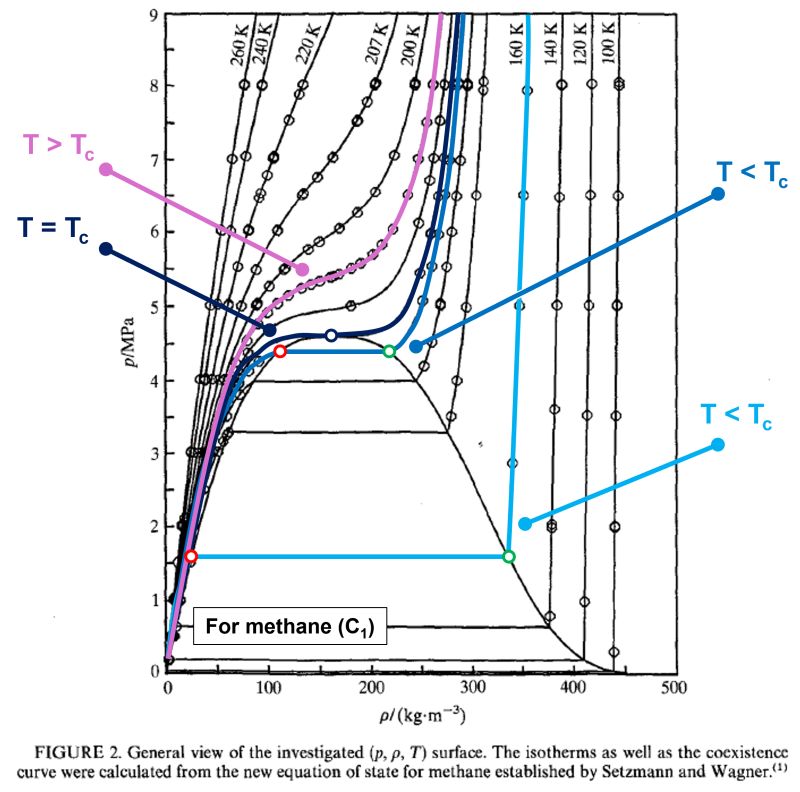
The fourth post introduces the first measured dataset: a methane dataset from a 1992 paper by Handel, Kleinrahm, and Wagner. Methane is used because it is a simple single-component system and a useful starting point for comparing model behavior.
Key ideas:
- The dataset covers pressure-density behavior over several temperatures.
- The chosen subset includes temperatures below methane's critical temperature, at the critical point, and above the critical point.
- The goal is to compare model predictions with measured methane data and make a qualified assessment from that comparison.
Source: Post 4
Post 5: Vanilla PR and SRK Both Struggle
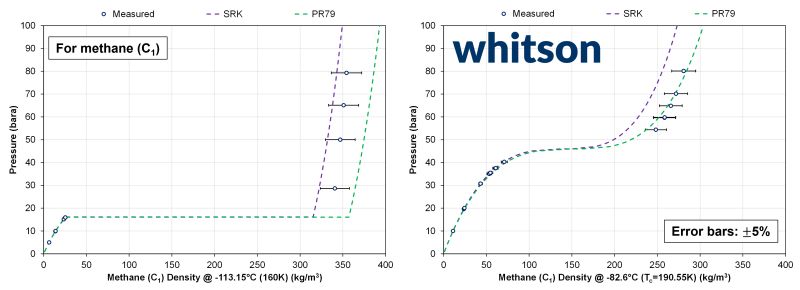
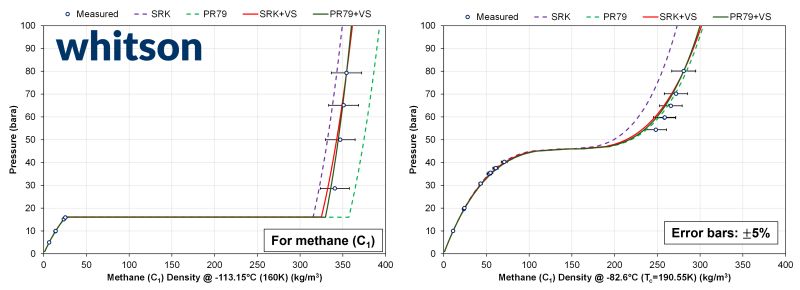
The fifth post compares unshifted, or "vanilla", PR and SRK predictions against measured methane data at two temperatures. The two examples include a 160 K case that crosses the vapor pressure and a 190 K case around methane's critical point.
Key ideas:
- The post intentionally uses vanilla PR and SRK without volume shifts.
- The purpose is to show the limitation, not to recommend these raw models.
- Both models are poor for liquid-like methane density prediction, depending on temperature.
- The post explicitly warns against using unshifted PR or SRK for engineering calculations where density accuracy matters.
Source: Post 5
Post 6: Volume Shifts Improve Both Models
The sixth post repeats the comparison after adding appropriate volume shifts for methane. With volume shifts included, both PR and SRK predict methane density much better.
In practical terms, a volume shift adjusts the calculated molar volume before converting to density:
where is the chosen volume shift.
Key ideas:
- The poor liquid-density behavior in the previous post is not a reason to declare one vanilla model the winner.
- Once volume shifts are included, both SRK and PR match methane density well for the cases shown.
- For the methane examples in this part of the series, PR and SRK are equally good so far.
- More data is needed before making a broader decision about which EOS is better.
Source: Post 6
Main Takeaways
- The PR vs SRK question should be answered with measured data, not habit or preference.
- PR and SRK are closely related cubic EOS models with different attractive-term forms.
- Vapor pressure and density-pressure plots are useful first checks for model behavior.
- Methane is a clean starting point because it is a single-component system with good measured data.
- Unshifted PR and SRK both struggle with liquid-like methane densities.
- Adding volume shifts greatly improves density prediction for both models.
- For the methane cases shown, neither PR nor SRK clearly wins after volume shifting.
- A serious comparison needs more fluids, more conditions, and measured data.
Practical Implications
When comparing cubic EOS models in engineering work, ask:
- What measured data are being used as the reference?
- Are we comparing model to data, or only model to model?
- Are the PR and SRK models using volume shifts?
- Which property matters most: vapor pressure, density, phase split, saturation pressure, or something else?
- Are we testing a single component, a simple mixture, or a real reservoir fluid?
- Are the EOS parameters tuned consistently?
The series makes a simple but important point: "PR vs SRK" is not a useful question unless the target data, calculation setup, and engineering objective are clear.